Software and SaaS M&A
Know the ARR is real before you pay a multiple on it.
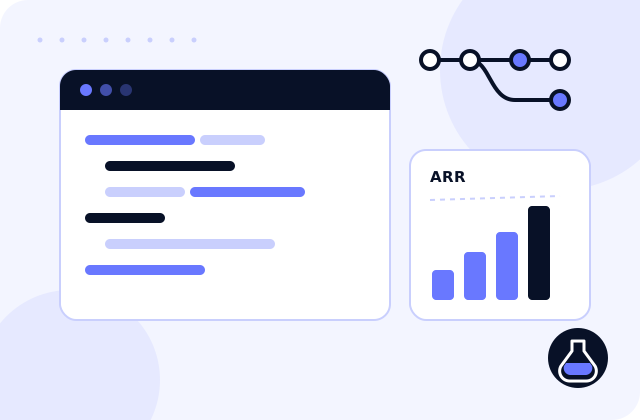
Software deals are priced on recurring revenue and on a codebase most buyers never read. Pactlab checks both from the source, and every finding a reviewer accepts flows straight into the price.
Where these deals go wrong
Strategic and private-equity acquisitions of software and SaaS companies, from tuck-ins to take-privates.
ARR that only exists in the deck
Management ARR rarely matches billing to the dollar, and the gap is where price risk hides.
One engineer holding the product
Interviews describe the team; the commit history shows who actually builds what.
Licences that come along for the ride
Copyleft components in a shipped product can change what you are buying.
The questions that decide the deal
- Does billed revenue support the ARR management reports?
- How sticky is revenue by cohort, and how concentrated is it?
- Who wrote the code, and does the business depend on one person?
- What licence and security exposure ships with the product?
- Can the team deliver the roadmap the plan assumes?
- Which contract terms change at closing?
How a deal runs with Pactlab
An illustrative walk through the decision loop on a software acquisition.
01 · Evidence
Billing exports, the repository and the delivery tracker are connected for the deal. Every record is hashed and kept with its source.
02 · Finding
Billed ARR falls short of the data book; a scanner flags a copyleft dependency; commit history shows one engineer behind the billing system.
03 · Review
A reviewer accepts the ARR gap with the bridge attached and asks for support on the licence finding before deciding.
04 · Valuation
The accepted risks become priced adjustments; the scenario re-runs and shows exactly how the price moved and why.
05 · Deal terms
The ARR gap becomes a price adjustment and the licence exposure an indemnity, each linked to its evidence.
What it finds — and what that becomes in the deal
Illustrative examples of findings and the terms they turn into. Every real finding carries citations and a named reviewer.
- High severityExample
Management ARR exceeds billed ARR
Invoice lines reconciled to the reported ARR figure
Purchase-price adjustment
- High severityExample
Copyleft component in the shipped agent
Software bill of materials at the scanned commit
Specific indemnity and remediation plan
- Medium severityExample
Billing subsystem depends on one contributor
Commit history, aggregated by subsystem
Retention arrangement in the integration plan
What Pactlab covers
The modules available today.
Revenue and SaaS metrics
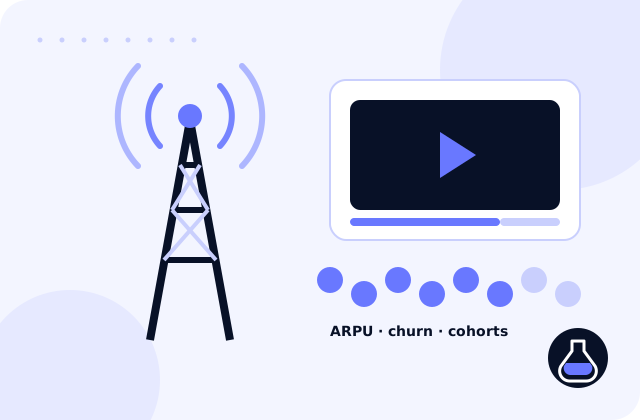
MRR, ARR, retention, cohorts, concentration and reconciliation.
Technology and code
Commit provenance, key-person risk, licence exposure and scans.
Delivery health
Completion against commitment, defect backlog and reopened work.
Documents and contracts
Clause extraction and Q&A with exact citations.
Valuation and deal terms
ARR-multiple, DCF and LBO scenarios with a purchase-price bridge.
What you walk away with
An approved ARR bridge
From the deck to the ledger, with the difference signed off.
A priced risk register
Every accepted finding with its evidence, reviewer and price range.
A frozen valuation
Submitted, approved by a second person and never rewritten.
Questions buyers ask
Does Pactlab keep our target’s source code?
No. Repositories are scanned in short-lived workspaces that are destroyed afterwards. Findings keep paths, hashes and tool versions — never code.
Who decides what is a real risk?
Your reviewers. Analysts, scanners and models can draft findings; only a named person can accept them, and nothing reaches the valuation until they do.
What do we need to start?
One live deal, access to its billing, code, delivery and documents, and the people who will review. That is what a pilot is.
Pilots with acquirers of software companies
We are working with a small number of design partners on live deals. If you buy or invest in software businesses, talk to us.